Song analysis: Relax by Frankie Goes to Hollywood
Introduction
Thesis statement
“Relax” by Frankie Goes to Hollywood represents a pivotal moment in 1980s popular music, where underground club culture collided with mainstream commercial success to create one of the most controversial and commercially successful singles in British music history. The song’s deliberate sexual ambiguity, combined with Trevor Horn’s innovative production techniques and the band’s provocative marketing campaign, transformed what could have been a niche dance track into a cultural phenomenon that challenged broadcasting standards and societal norms. Through its celebration of hedonistic pleasure disguised as motivational advice, “Relax” became both a symbol of the Reagan-era’s cultural tensions and a blueprint for how controversy could be weaponized for commercial gain. The track’s enduring legacy lies not just in its catchy hooks and dancefloor appeal, but in its demonstration that popular music could simultaneously embrace and subvert mainstream values, creating a template for future artists seeking to push boundaries while achieving mass market success.
Brief introduction to the song and artist
Frankie Goes to Hollywood emerged from Liverpool’s post-punk scene in the early 1980s, formed around the charismatic frontman Holly Johnson and his distinctive vocal style that blended theatrical performance with raw sexual energy. The band’s name, derived from a newspaper headline about Frank Sinatra’s move to Hollywood, reflected their ambitions to transcend their working-class origins through pop stardom. Johnson, who had previously performed with the band Big in Japan, brought a background in Liverpool’s underground gay club scene that would heavily influence the band’s aesthetic and musical direction. The group’s other members included Paul Rutherford on vocals, Peter Gill on drums, Mark O’Toole on bass, and Brian Nash on guitar, though their contributions to the final recording were largely replaced by session musicians. Their association with producer Trevor Horn and his ZTT Records label provided them with the resources and creative freedom to develop their provocative artistic vision. The band’s emergence coincided with the rise of MTV and music video culture in America, positioning them perfectly to capitalize on the visual medium’s potential for controversy and spectacle.
Context of the song’s creation and release
“Relax” was conceived in 1982 during a period of significant cultural and political upheaval in both Britain and America, with conservative governments in power and rising tensions around issues of sexuality and morality. The song emerged from Liverpool’s vibrant club scene, where Johnson had observed the intersection of sexual liberation and musical expression that characterized the early 1980s dance culture. Producer Trevor Horn, fresh from his success with The Buggles and Yes, was experimenting with new sampling technology and digital production techniques that would revolutionize popular music production. The multiple recording sessions that produced the final version reflected the technological possibilities of the era, with Horn utilizing the Fairlight CMI synthesizer and LM-2 drum machine to create sounds that were impossible to achieve with traditional instrumentation. The song’s development paralleled America’s growing culture wars, with religious conservatives gaining political influence while underground cultures pushed for greater sexual and artistic freedom. The track’s release in October 1983 coincided with the emergence of HIV/AIDS as a public health crisis, adding an unintended layer of complexity to its celebration of sexual pleasure and its eventual controversy.
Overview of the song’s reception and impact
“Relax” initially struggled to find commercial success, stalling at number 77 on the UK charts before a performance on Channel 4’s “The Tube” helped propel it toward mainstream recognition. The song’s breakthrough came when BBC Radio 1 DJ Mike Read famously stopped the record mid-play and declared it unsuitable for broadcast, creating a controversy that transformed the track from a minor club hit into a cultural phenomenon. American audiences initially showed less interest, with the song reaching only number 67 in late 1984, but the track’s success grew following the release of the album “Welcome to the Pleasuredome” and reached number 10 in early 1985. The BBC’s ban inadvertently created a marketing campaign that money couldn’t buy, with other radio stations promoting themselves as “the station that plays the song the BBC banned,” driving massive sales and cultural attention. The track’s impact extended beyond music into fashion and popular culture, with “Frankie Say Relax” t-shirts becoming a ubiquitous symbol of 1980s youth rebellion and sexual liberation. The song’s success demonstrated the power of controversy in the emerging global media landscape, establishing a template that would influence artists from Madonna to Eminem in their approach to pushing boundaries while achieving commercial success.
Lyrical analysis
Breakdown of the song’s lyrics
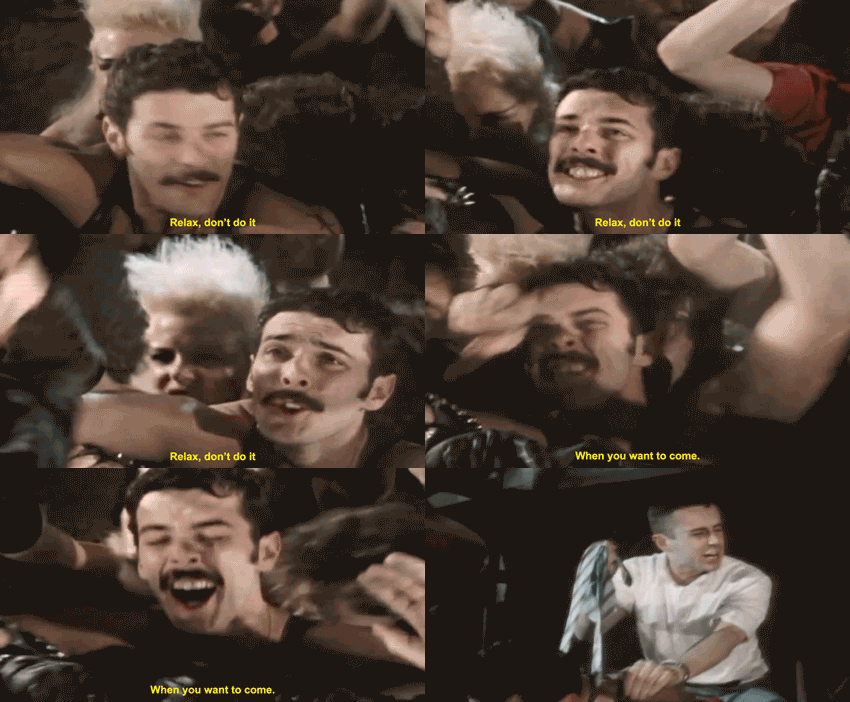
The song’s lyrics operate on multiple levels of meaning, with the surface-level message of relaxation serving as a thin veneer over explicit sexual content that becomes increasingly apparent through repetition and context. The opening imperative “Relax, don’t do it” establishes a paradoxical tension between restraint and desire that runs throughout the track, suggesting both self-control and its inevitable abandonment. The phrase “when you want to come” functions as the song’s central double entendre, simultaneously referencing arrival and sexual climax in a way that allows for plausible deniability while maintaining its provocative edge. The verses introduce imagery of “laser beams” and “shooting in the right direction,” blending science fiction metaphors with sexual innuendo in a manner that reflects the era’s fascination with technology and futurism. The repeated use of imperatives creates a hypnotic, almost instructional quality that mirrors both dance music’s function as physical direction and the song’s underlying sexual content. The fragmented nature of the lyrics, with their repetitive structure and sudden interjections, mirrors the physical and emotional intensity of both dancing and sexual experience, creating a sonic representation of building tension and release.
Top five most used words in the lyrics
The most frequently used words in “Relax” reveal the song’s thematic preoccupations and structural approach to building tension and release. “Relax” appears most frequently as both the song’s title and its central command, functioning as both instruction and ironic commentary on the impossibility of relaxation in the face of desire. “Come” serves as the song’s primary double entendre, appearing in various contexts that blur the line between movement and sexual climax. “When” appears repeatedly to establish temporal conditions, creating a sense of anticipation and inevitability that drives the song’s momentum. “Don’t” functions as the primary prohibition, establishing the tension between desire and restraint that gives the song its psychological complexity. “Want” appears frequently to emphasize the role of desire in driving the song’s narrative, establishing the emotional stakes that make the command to “relax” both necessary and impossible. These words create a linguistic pattern that mirrors the song’s musical structure, with repetition building intensity while maintaining the ambiguity that allowed the song to achieve mainstream success despite its controversial content.
Exploration of themes and motifs
The song explores three primary themes that intersect to create its complex cultural meaning and enduring appeal. The theme of sexual liberation appears throughout the track, with its celebration of physical pleasure serving as both personal expression and political statement during an era of conservative moral backlash. The tension between public restraint and private desire reflects broader cultural anxieties about sexuality and respectability that characterized the 1980s, particularly in the context of the emerging AIDS crisis and religious conservative activism. The motif of technology appears in the “laser beam” imagery and the song’s heavily electronic production, suggesting a futuristic vision of human sexuality freed from traditional moral constraints. The theme of rebellion manifests in the song’s challenge to broadcasting standards and social norms, with its very existence serving as a form of cultural resistance to conservative values. These themes converge to create a song that functions simultaneously as dance track, cultural critique, and commercial product, demonstrating the complex ways that popular music can embody and challenge social values.
Use of literary devices
The song employs several literary devices to achieve its effects and maintain its provocative ambiguity. Double entendre serves as the primary device, with phrases like “when you want to come” allowing for multiple interpretations that create the song’s sexual tension while maintaining plausible deniability. Repetition functions both as musical device and rhetorical strategy, with the repeated imperatives creating a hypnotic effect that mirrors both dance music’s physical function and the psychological impact of sexual desire. Metaphor appears in the “laser beam” imagery, which transforms sexual desire into science fiction fantasy while maintaining the song’s futuristic aesthetic. Imperatives dominate the lyrical structure, creating a sense of urgency and command that reflects both the song’s dance function and its sexual content. Fragmentation characterizes the song’s approach to narrative, with incomplete phrases and sudden interjections creating a sense of breathless excitement that mirrors both physical exertion and sexual arousal. These devices work together to create a song that operates on multiple levels of meaning, allowing listeners to engage with its content according to their own comfort level and cultural context.
Emotional journey mapping
The song’s emotional arc follows a pattern of building tension and release that mirrors both musical and sexual structure. The track begins with a sense of anticipation and restraint, as the opening commands establish the central tension between desire and control. The emotional intensity builds through repetition and the introduction of increasingly explicit imagery, creating a sense of mounting pressure that drives the song’s momentum. The middle section introduces elements of fantasy and escape through the “laser beam” imagery, providing a brief respite from the song’s central tension while maintaining its underlying sexual energy. The final section achieves a sense of release through the abandonment of restraint and the embrace of physical pleasure, creating a climactic moment that resolves the song’s central conflict. Throughout this journey, the emotional tone remains celebratory rather than anxious, suggesting that the song’s ultimate message is one of liberation rather than transgression.
Musical composition
Technical analysis
“Relax” represents a masterclass in early 1980s electronic production, built around a foundation of drum machine programming that would influence dance music for decades to come. The track’s structure relies heavily on the LM-2 drum machine, programmed with a pattern that combines the steady pulse of disco with the more aggressive attack of emerging house music styles. The bassline, created through a combination of synthesizer programming and traditional bass guitar, provides the song’s harmonic foundation while creating a sense of forward momentum that drives the track’s relentless energy. The song’s key center in E minor provides a darker harmonic backdrop that contrasts with the celebratory nature of the lyrics, creating a musical tension that mirrors the song’s thematic content. The chord progression follows a relatively simple pattern that emphasizes the dominant and subdominant relationships, allowing the rhythmic elements to take precedence while providing enough harmonic interest to sustain the song’s extended length. The arrangement builds through the strategic introduction of new elements, with each section adding layers of complexity while maintaining the clarity necessary for both radio play and dancefloor functionality. The song’s structure defies traditional pop conventions, with its extended length and repetitive sections reflecting the influence of club culture and the emerging remix aesthetic that would dominate 1980s dance music.
Instrumentation breakdown
The final version of “Relax” features a carefully crafted combination of electronic and traditional instruments that creates its distinctive sonic signature. The drum programming, handled by the LM-2 drum machine, provides the track’s rhythmic foundation with a sound that was revolutionary for its time and remains influential in contemporary electronic music production. Steve Lipson’s guitar work adds texture and harmonic complexity, with his playing style bridging the gap between traditional rock instrumentation and the emerging electronic aesthetic. Andy Richards’ keyboard programming contributes both harmonic support and melodic interest, utilizing the advanced synthesizer technology available in Trevor Horn’s studio to create sounds that were impossible to achieve with traditional instruments. J.J. Jeczalik’s work on the Fairlight CMI synthesizer provides the song’s most distinctive sonic elements, including the sampling and sound manipulation that gives the track its futuristic character. Holly Johnson’s vocals, recorded at 4 AM after an extended session, capture a sense of raw energy and abandon that perfectly complements the song’s thematic content. The production technique of layering multiple instrumental elements creates a wall of sound that maintains clarity while achieving maximum impact, demonstrating the possibilities of digital recording technology in the early 1980s.
Vocal analysis
Holly Johnson’s vocal performance on “Relax” represents one of the most distinctive and influential vocal styles in 1980s popular music, characterized by its deliberate use of microtones and vocal slurs that create a sense of sexual ambiguity and emotional intensity. Johnson’s approach to pitch deliberately avoids traditional pop vocal conventions, instead embracing a style that Trevor Horn initially thought was out of tune but recognized as intentionally expressive. The vocal delivery alternates between whispered intimacy and aggressive command, creating a dynamic range that mirrors the song’s thematic content and emotional arc. Johnson’s use of melisma and vocal ornaments adds a gospel-influenced quality to the performance, connecting the song to African American musical traditions while maintaining its distinctly British character. The vocal arrangement includes strategic use of harmony and overdubbing, creating a sense of multiple voices that suggests both community and sexual multiplicity. The performance’s raw energy, captured during an extended late-night recording session, conveys a sense of authenticity and abandon that contrasts with the song’s highly produced instrumental track, creating a tension between spontaneity and calculation that defines the song’s overall aesthetic.
Production techniques
Trevor Horn’s production of “Relax” pioneered several techniques that would become standard in electronic music production, utilizing the most advanced digital technology available in 1983 to create a sound that was both contemporary and futuristic. The use of the Fairlight CMI sampling synthesizer allowed for the manipulation of sounds in ways that were impossible with traditional recording methods, creating the song’s distinctive electronic textures and effects. The layering of multiple drum machine patterns created a rhythmic complexity that maintained clarity while achieving massive sonic impact, establishing a template for electronic dance music production that remains influential today. Horn’s approach to mixing emphasized the use of compression and equalization to create a sense of space and dimension, with each element occupying its own frequency range while contributing to the overall sonic picture. The production’s use of digital delay and reverb effects created a sense of space and atmosphere that enhanced the song’s emotional impact while maintaining the clarity necessary for radio play. These techniques, combined with Horn’s understanding of both pop song structure and club culture, created a production that satisfied both mainstream commercial requirements and underground dance music aesthetics.
Cultural and social context
Historical context
“Relax” emerged during a period of significant cultural and political tension in both Britain and America, with conservative governments promoting traditional values while underground cultures pushed for greater sexual and artistic freedom. The song’s release in October 1983 coincided with the height of the Cold War, the emergence of MTV as a cultural force, and the beginning of the AIDS crisis, creating a complex backdrop for its celebration of sexual pleasure and hedonistic lifestyle. The track’s success paralleled the rise of youth culture as a distinct economic and cultural force, with young people possessing unprecedented disposable income and cultural influence. The song’s controversy reflected broader debates about censorship, morality, and artistic freedom that characterized the Reagan-Thatcher era, with its BBC ban serving as a flashpoint for discussions about media responsibility and cultural values. The track’s commercial success demonstrated the growing power of youth culture to challenge establishment values through consumer choice, establishing a template for future controversies that would shape popular music marketing. The song’s impact extended beyond music into fashion and lifestyle, with “Frankie Say Relax” merchandise becoming symbols of rebellion and sexual liberation that defined 1980s youth culture.
Artist’s personal context
Holly Johnson’s background as a gay man in Liverpool’s underground club scene provided the authentic foundation for “Relax”‘s celebration of sexual liberation and its challenge to mainstream moral values. Johnson’s experience with his previous band Big in Japan had introduced him to the possibilities of performance as both artistic expression and personal liberation, experiences that directly informed his approach to “Relax.” His immersion in Liverpool’s gay club culture exposed him to musical styles and attitudes that were largely invisible to mainstream British society, providing the inspiration for the song’s blend of sexual explicitness and dance music aesthetics. Johnson’s personal experience of marginalization and discrimination informed the song’s subversive approach to mainstream success, with its coded language allowing for the expression of gay themes within a commercial pop context. The artist’s willingness to embrace controversy and challenge social norms reflected both personal conviction and strategic calculation, understanding that authenticity and provocation could be powerful tools for achieving both artistic and commercial success. Johnson’s later openness about his sexuality and his activism during the AIDS crisis provided additional context for understanding “Relax” as not just entertainment but as a form of cultural and political expression.
Societal impact
“Relax” functioned as a cultural catalyst that forced British and American society to confront questions about sexuality, censorship, and the role of popular culture in shaping social values. The BBC’s ban on the song created a national conversation about media responsibility and artistic freedom, with the controversy ultimately demonstrating the futility of censorship in the emerging global media landscape. The track’s success among young people while facing official condemnation highlighted the generational divide that characterized 1980s culture, with older authorities struggling to maintain control over rapidly changing social norms. The song’s impact on fashion and lifestyle extended far beyond music, with “Frankie Say Relax” becoming a ubiquitous symbol of youth rebellion that appeared on everything from t-shirts to badges. The track’s influence on subsequent artists demonstrated its role in expanding the boundaries of acceptable content in popular music, paving the way for future controversies and challenges to mainstream values. The song’s enduring popularity and cultural significance reflected its success in capturing and expressing the tensions and anxieties of its era while providing a template for how popular culture could challenge and ultimately change social attitudes.
Legacy and covers
“Relax” has maintained its cultural significance through numerous covers and references that demonstrate its enduring influence on popular music and culture. Notable covers include versions by artists ranging from Duran Duran to Robbie Williams, each interpretation highlighting different aspects of the song’s appeal and meaning. The track’s influence on electronic dance music production can be heard in countless subsequent recordings, with its combination of drum machine programming and sexual provocation becoming a template for genre development. The song’s visual aesthetic, established through its controversial music videos and merchandise, has been referenced and parodied in numerous contexts, demonstrating its iconic status in popular culture. The track’s legacy extends beyond music into broader discussions about censorship, artistic freedom, and the role of controversy in commercial success, with its BBC ban serving as a case study in media studies and cultural analysis. The song’s continued relevance in contemporary discussions about sexuality, identity, and artistic expression demonstrates its success in transcending its original cultural context to become a lasting statement about the power of popular music to challenge and change social attitudes.
Philosophical comparison
Western philosophy connections
“Relax” embodies several key concepts from Western philosophical tradition, particularly the tension between hedonistic pleasure and moral restraint that has defined philosophical discourse since ancient times. The song’s celebration of immediate gratification reflects the hedonistic philosophy of Epicurus, who argued that pleasure is the highest good and that the pursuit of happiness justifies the abandonment of conventional moral constraints. The track’s challenge to authority and social norms connects to the existentialist tradition, particularly the work of Jean-Paul Sartre, who emphasized individual freedom and the responsibility to create one’s own values in opposition to social convention. The song’s use of ambiguity and double meaning reflects postmodern philosophical concerns with the instability of meaning and the impossibility of fixed interpretation, suggesting that truth is always contextual and subjective. The track’s commercial success while maintaining artistic integrity engages with Marxist critiques of capitalism and culture, demonstrating how subversive content can be incorporated into commercial systems while maintaining its revolutionary potential. The song’s emphasis on physical pleasure and bodily experience connects to phenomenological philosophy, particularly the work of Maurice Merleau-Ponty, who emphasized the body as the primary site of knowledge and experience.
Eastern philosophy connections
The song’s central message of relaxation and the abandonment of striving connects to Buddhist concepts of non-attachment and the recognition that desire leads to suffering. The track’s emphasis on living in the present moment, suggested by its focus on immediate physical pleasure, reflects mindfulness practices that emphasize awareness of current experience rather than future goals or past regrets. The song’s celebration of sexual energy connects to Tantric traditions that view sexual experience as a path to spiritual enlightenment and transcendence of ordinary consciousness. The track’s use of repetition and mantric qualities mirrors meditation techniques that use repetitive sounds or phrases to achieve altered states of consciousness and spiritual insight. The song’s challenge to conventional morality reflects the Zen tradition’s emphasis on transcending dualistic thinking and conventional categories of right and wrong. The track’s integration of opposing forces—restraint and abandon, public and private, sacred and profane—connects to Taoist concepts of balance and the unity of opposites that characterizes enlightened understanding.
Religious and spiritual themes
“Relax” engages with religious and spiritual themes through its exploration of transcendence, ecstasy, and the sacred dimension of physical experience. The song’s celebration of sexual pleasure connects to traditions that view physical love as a form of spiritual practice, including the Christian mystic tradition and various forms of sacred sexuality. The track’s use of imperative commands mirrors the language of religious instruction and spiritual guidance, suggesting that its message carries moral and spiritual weight beyond mere entertainment. The song’s emphasis on letting go and surrendering control reflects spiritual practices that emphasize the abandonment of ego and the acceptance of divine will or natural flow. The track’s controversial reception and subsequent vindication parallel the experience of religious prophets and spiritual teachers who challenge conventional morality and face persecution for their message. The song’s enduring cultural significance and ability to inspire devotion among fans reflects its function as a form of secular spirituality that provides meaning and community in an increasingly fragmented world. The track’s celebration of joy and pleasure connects to religious traditions that emphasize the goodness of creation and the appropriateness of celebrating life’s gifts.
Psychological perspectives
From a psychological perspective, “Relax” can be understood as an exploration of the tension between the id and superego, with the song’s message representing the id’s demand for immediate gratification against the superego’s moral constraints. The track’s use of repetition and hypnotic rhythms creates a psychological state that mirrors the altered consciousness associated with both sexual experience and various forms of therapy and healing. The song’s celebration of pleasure and rejection of guilt connects to humanistic psychology’s emphasis on self-actualization and the importance of accepting all aspects of human experience. The track’s controversial reception and subsequent vindication demonstrate the psychological mechanisms of moral panic and social change, showing how societies process and ultimately integrate challenging new ideas. The song’s ability to create a sense of community and shared identity among fans reflects the psychological importance of music in forming group identity and providing emotional support and validation.
Conclusion
Summary of findings
This analysis has revealed “Relax” by Frankie Goes to Hollywood as a complex cultural artifact that successfully navigated the intersection of underground authenticity and mainstream commercial success during a pivotal moment in popular music history. The song’s innovative production techniques, pioneered by Trevor Horn, established new standards for electronic music production while its provocative content challenged broadcasting standards and social norms. The track’s lyrical ambiguity, employing double entendre and coded language, allowed for the expression of explicitly sexual themes within a commercial pop context, demonstrating the power of artistic subtlety in achieving both artistic and commercial goals. The song’s cultural impact extended far beyond music, influencing fashion, lifestyle, and broader discussions about censorship, artistic freedom, and the role of popular culture in social change. The track’s enduring legacy in both musical and cultural terms demonstrates its success in transcending its original context to become a lasting statement about the power of popular music to challenge and ultimately change social attitudes. The song’s philosophical and spiritual dimensions, connecting to traditions from both Eastern and Western thought, reveal its deeper significance as an exploration of fundamental human experiences and desires. The analysis confirms that “Relax” represents a masterpiece of 1980s popular culture that continues to influence artists and audiences more than four decades after its release.
Personal interpretation
“Relax” ultimately represents a celebration of human pleasure and authenticity that transcends its specific cultural context to speak to universal desires for freedom, joy, and connection. The song’s genius lies in its ability to smuggle subversive content into mainstream culture through the vehicle of an irresistibly catchy dance track, demonstrating that the most effective forms of social change often come disguised as entertainment. The track’s embrace of controversy and its willingness to challenge authority reflects a fundamentally optimistic view of human nature and social progress, suggesting that truth and authenticity will ultimately prevail over repression and hypocrisy. The song’s celebration of physical pleasure and emotional authenticity offers a vision of human life that prioritizes immediate experience over abstract moral principles, providing a valuable counterbalance to the often oppressive demands of social convention. The track’s enduring popularity and cultural significance demonstrate its success in capturing something essential about the human experience that resonates across different generations and cultural contexts. The song’s ability to create joy and community among its listeners reflects its ultimate function as a form of secular spirituality that provides meaning and connection in an increasingly fragmented world. In this interpretation, “Relax” emerges not just as a pop song but as a manifesto for a more authentic and joyful way of living.
Critical evaluation
From a critical perspective, “Relax” must be evaluated as both an artistic achievement and a commercial product, with its success in both realms representing a rare accomplishment in popular music history. The song’s innovative production techniques and distinctive sonic signature demonstrate genuine artistic innovation that influenced subsequent developments in electronic and dance music. The track’s lyrical sophistication, employing multiple layers of meaning and sophisticated literary devices, elevates it above typical commercial pop music while maintaining broad accessibility. The song’s cultural impact and ability to generate meaningful discussion about important social issues demonstrates its significance as a work of art that engages with serious themes while entertaining its audience. However, the track’s commercial success and calculated use of controversy raise questions about the relationship between artistic integrity and commercial manipulation, suggesting that its subversive content may have been as much marketing strategy as genuine artistic expression. The song’s focus on hedonistic pleasure and rejection of moral constraint, while liberating in its original context, may seem less revolutionary in contemporary culture where such attitudes have become more widely accepted. Despite these potential limitations, the song’s enduring influence and continued relevance demonstrate its fundamental artistic merit and its success in achieving both immediate commercial impact and lasting cultural significance.
 be-song-be-you.com
Leave a comment